
The traditional model of providing care is largely based on a first-come, first-served basis that is modified by acuity. Using the Emergency Severity Index, patients are first triaged and grouped by their severity level, with critical patients being treated immediately, and less emergent cases being treated largely in the order in which they presented to the ED. This linear model treats patients the same way, with standard exam rooms, process steps, and discharge processes.
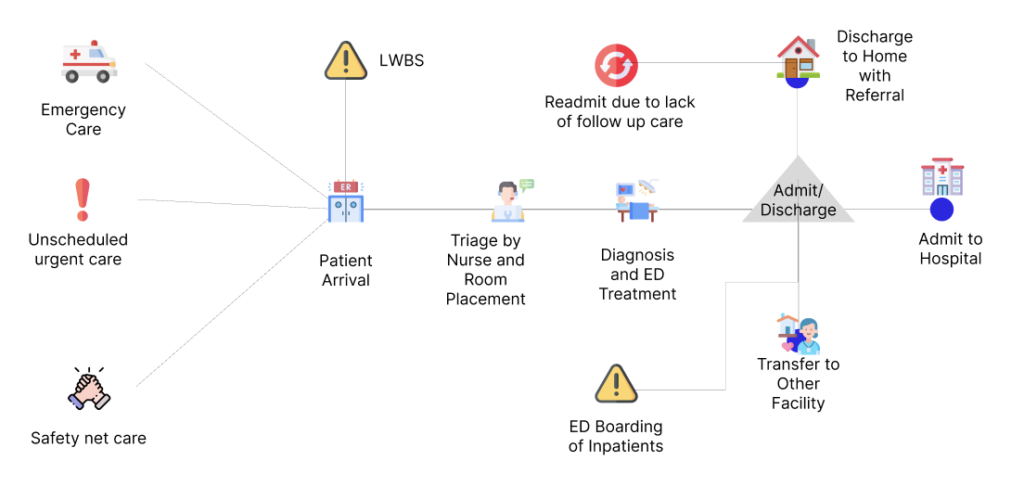
This traditional model contributes to many of the the overcrowding and throughput issues emergency departments see.1 The model creates bottlenecks that reduces quality of service for all patients, but significantly affects lower-acuity patients.
This is especially true for large EDs, especially at academic medical centers where EDs see higher volumes of higher-acuity patients.
References:
- Joseph JW, White BA. Emergency Department Operations: An Overview. Emerg Med Clin North Am. 2020 Aug;38(3):549-562. doi: 10.1016/j.emc.2020.04.005. Epub 2020 Jun 10. PMID: 32616278.
