
Overview
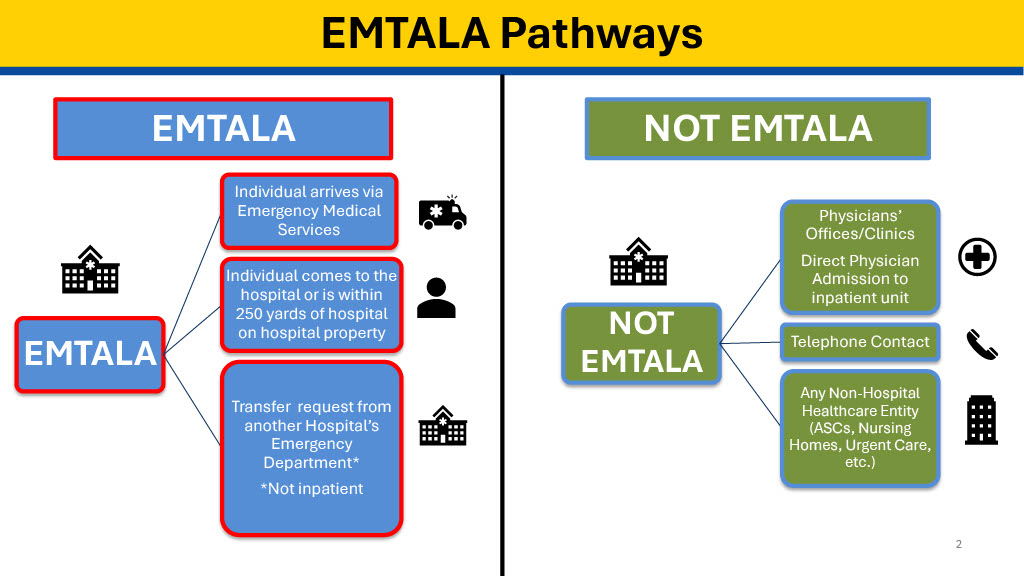
The Emergency Medical Treatment & Labor Act (EMTALA) was enacted by Congress in 1986. The intent is to ensure public access to emergency services. EMTALA requires that if a patient presents for care at a Medicare-participating hospital with an emergency department, the hospital must provide a medical screening examination (MSE) and provide stabilizing treatment for any emergency medical condition (EMC).
EMTALA requirements end when a patient is:
- Screened by a physician or qualified medical personnel and does not have an EMC
- Stabilized to resolve the EMC
- Admitted to the hospital as an inpatient (not observation status)
- Safely transferred to another hospital
- At any time if the individual refuses care
If EMTALA is violated:
- CMS can terminate the hospital from the Medicare program
- HHS Office of the Inspector General can impose fines against hospitals and/or physicians
Relevance to this Project
Because of EMTALA, emergency departments often treat patients with minor injuries and illnesses for patients who for a variety of reasons are not able to access more appropriate levels of care. For instance, urgent care clinics are able to refuse care to patients who are uninsured or unable to pay, leaving them with few other options for immediate care. These types of cases contributes to the bottlenecking in the ED flow model and are often the patients who leave without being seen or are unhappy with the service they recieve.
References
1. Emergency Medical Treatment & Labor Act (EMTALA) | CMS (https://www.cms.gov/medicare/regulations-guidance/legislation/emergency-medical-treatment-labor-act)
2. EMTALA Information (https://www.cms.gov/files/document/overview-emtala-process.pdf)
